


CrossTL translates GPU shaders and compute kernels between languages. Every translation goes through CrossGL, a small intermediate language: a frontend imports GLSL, HLSL, Metal or another source language into CrossGL, and a code generator writes CrossGL out as GLSL, HLSL, Metal, SPIR-V, WGSL or another target. You can also write CrossGL directly and generate every target from one source file.
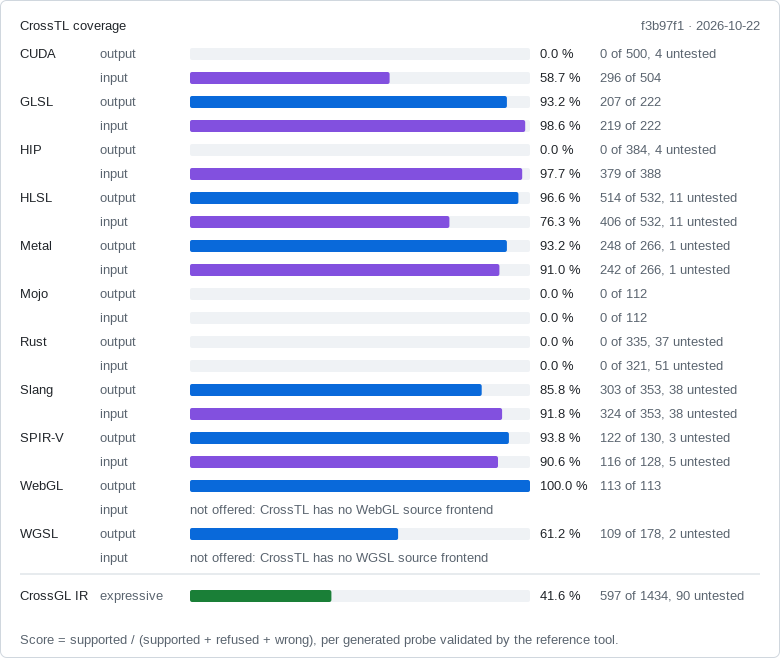
CI rebuilds this chart on every push to main and every night. Each language has a feature list generated from
pinned upstream specifications and compiler tables. Every feature gets a probe: CrossTL translates it, and the
language's reference compiler or validator checks the result. Where CI has a runtime for the language, on a GPU, on
Mesa's software drivers or on Direct3D 12 WARP, the translated compute probes also run and must compute what the
native probes compute.
CI has no runtime for CUDA, HIP, OpenCL C, Mojo, GLSL ES or WebGL, so the chart marks those rows compile-only. The
score is supported / (supported + refused + wrong). COVERAGE.md
defines each outcome and lists every gap behind each bar.
pip install crosstlCrossTL needs Python 3.11 or later. Validating the generated code needs the target's own compiler or validator
(glslang, DXC, spirv-tools, naga, the Metal compiler, nvcc, hipcc, slangc, rust-gpu or the Mojo compiler), which
CrossTL does not install. crosstl doctor lists the tools it looks for and which of them are on PATH.
Save this compute kernel as saxpy.cgl:
shader Saxpy {
    compute {
        layout(local_size_x = 64, local_size_y = 1, local_size_z = 1) in;
        buffer float* x;
        buffer float* y;
        uniform float a;

        void main() {
            uint i = gl_GlobalInvocationID.x;
            y[i] = a * x[i] + y[i];
        }
    }
}
Then translate it from Python, where the source language comes from the file extension:
import crosstl

metal = crosstl.translate("saxpy.cgl", backend="metal")
crosstl.translate("saxpy.cgl", backend="wgsl", save_shader="saxpy.wgsl")

# A native shader is imported into CrossGL first, then generated for the target.
glsl = crosstl.translate("blur.hlsl", backend="opengl")
crossgl = crosstl.translate("blur.hlsl", backend="cgl")
or from the command line, where the target comes from the output file's extension:
crosstl saxpy.cgl -o saxpy.hlsl
crosstl blur.hlsl -o blur.metal
crosstl translate saxpy.cgl --backend vulkan --output -
--backend chooses the target explicitly; without it, -o - writes CrossGL to standard output. An output file
name whose extension names no language CrossTL writes is refused. python -m crosstl is the same command. The
examples/ directory has larger CrossGL programs.
| Language | backend |
Output | Input |
|---|---|---|---|
| GLSL | opengl |
measured | measured |
| HLSL | directx |
measured | measured |
| Metal | metal |
measured | measured |
| SPIR-V assembly | vulkan |
measured | measured |
| WGSL | wgsl |
measured | measured |
| GLSL ES 3.00 (WebGL 2) | webgl |
measured | measured |
| CUDA | cuda |
measured | measured |
| HIP | hip |
measured | measured |
| Slang | slang |
measured | measured |
| Rust (rust-gpu) | rust |
measured | measured |
| Mojo | mojo |
measured | measured |
| OpenCL C | not offered | measured |
A measured direction has a row in COVERAGE.md, and
each language has a page of its own with its
scores by category, the language pairs it translates to and from, and every gap.
CrossTL has no OpenCL C generator, so the OpenCL C input row checks the HLSL that CrossTL writes from each OpenCL C
probe. The language names glsl, hlsl, msl and spirv work as backend names too, and cgl writes the CrossGL a
native source imports to. backend="gles" writes GLSL ES 3.x for OpenGL ES, which has rows of its own in both
directions. CrossGL has its own coverage row, CrossGL IR, which measures how many of the features of all the measured
output languages CrossGL can express.
CrossTL is meant to fail closed: a construct it cannot translate raises a diagnostic that names the construct and the target, instead of emitting a placeholder. Output that the reference tool rejects, or that has a comment saying CrossTL wrote a placeholder, counts as wrong in the coverage report, and the Coverage workflow files it as a bug.
 .hlsl .metal .glsl .cu ...                                        .glsl .hlsl .metal .spvasm .wgsl ...
 native source --> frontend --> CrossGL source --> CrossGL parser --> code generator --> target source
                   (parse and                      (AST and types)     (one per target)
                    import)
Each source language has a frontend in crosstl/backend/<Language>/ that parses it and writes CrossGL. The CrossGL
parser in crosstl/translator/ builds the typed AST that every code generator in crosstl/translator/codegen/
reads, so a feature added to CrossGL is available to every target that can express it.
For a project with many shader or kernel sources, scan it before writing anything, then translate it and check the report:
python -m crosstl scan path/to/repo --target metal --output scan-report.json
python -m crosstl translate-project path/to/repo --target metal --output-dir crosstl-out \
  --report crosstl-out/report.json
python -m crosstl validate-project crosstl-out/report.json --format text
python -m crosstl inspect-report crosstl-out/report.json --format text
A relative --output-dir is resolved against the project, so the translated files land in
path/to/repo/crosstl-out/<target>/. The report records each translated file, its diagnostics and provenance, the
reference toolchain checks that ran, and the host-side changes that remain manual. The project porting guide covers
the options, and demos/ has pinned open-source ports with checked artifacts.
The user documentation is at docs.crossgl.net.
The Sphinx sources, including the architecture notes and decision records, are in docs/source.
Read CONTRIBUTING.md for setup, the test tiers and the pull request flow. Issues labelled good first issue are a good place to start, and questions belong in Discussions or on Discord. Report security problems as described in SECURITY.md.
If you use CrossTL in your work, cite it with the metadata in CITATION.cff; GitHub's "Cite this repository" button produces BibTeX and APA from it. Each release is archived on Zenodo under 10.5281/zenodo.15826974.
CrossTL is licensed under the Apache License 2.0.