

pelagos-py processes glider and other autonomous-platform data in OG1 format into science-ready datasets. A pipeline is a sequence of steps (loading, quality control, corrections, export) built from a single YAML config file, so processing can be reproduced by sharing the config.
pip install pelagos-pyOr from source:
git clone https://github.com/NOC-OBG-Autonomy/pelagos-py.git
cd pelagos-py
pip install -e .Build a config for the demo file (downloaded on first use) and run it:
from pelagos_py import Pipeline, get_demo_file

pipeline = Pipeline.make_config(get_demo_file())
pipeline.run()
make_config saves the config as a YAML file next to the data, ready to edit and rerun with Pipeline.load_config.
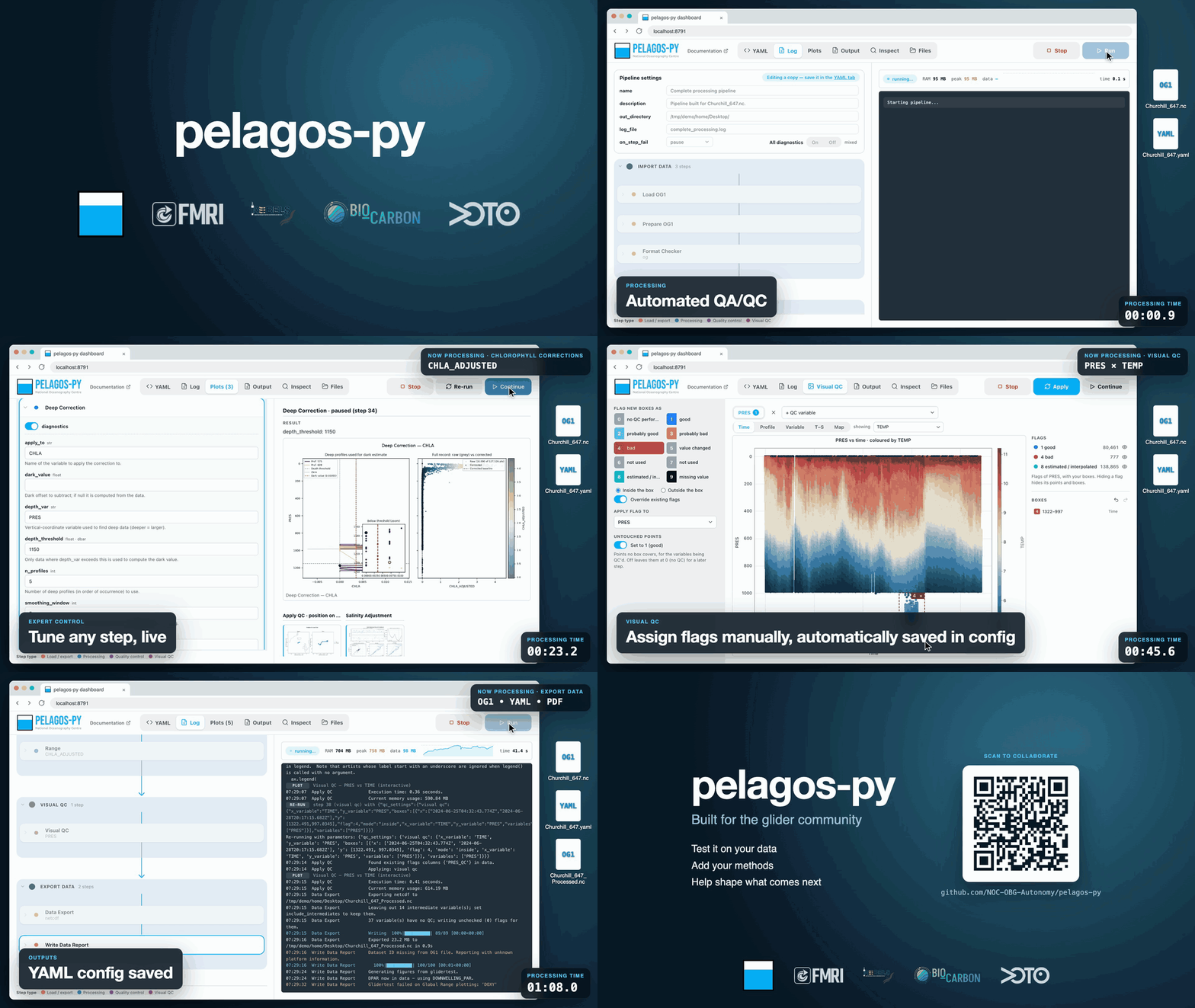
A local web page to build, check and run configs, with live logs and diagnostic plots:
pelagos-py dashboard # opens http://localhost:8791pelagos-py build glider.nc # writes glider.yaml
pelagos-py run glider.nc # builds a config, then runs it
pelagos-py run my_pipeline.yaml # runs an existing config
pelagos-py demo # downloads the demo file and prints its path- Getting Started: installation, running a pipeline and an example config
- User Guide: how each variable is processed
- API Reference: every step and its parameters
- Contributing: reporting issues and developing pelagos-py
Copyright 2025-2026 The National Oceanography Centre and contributors.