
Cut big tool outputs, logs and documents in half before your LLM reads them, without mangling IDs. A 140M-parameter model deletes the least useful words; everything it keeps is passed on byte for byte. Runs on CPU in about 0.1 s per 500 tokens. Apache-2.0.
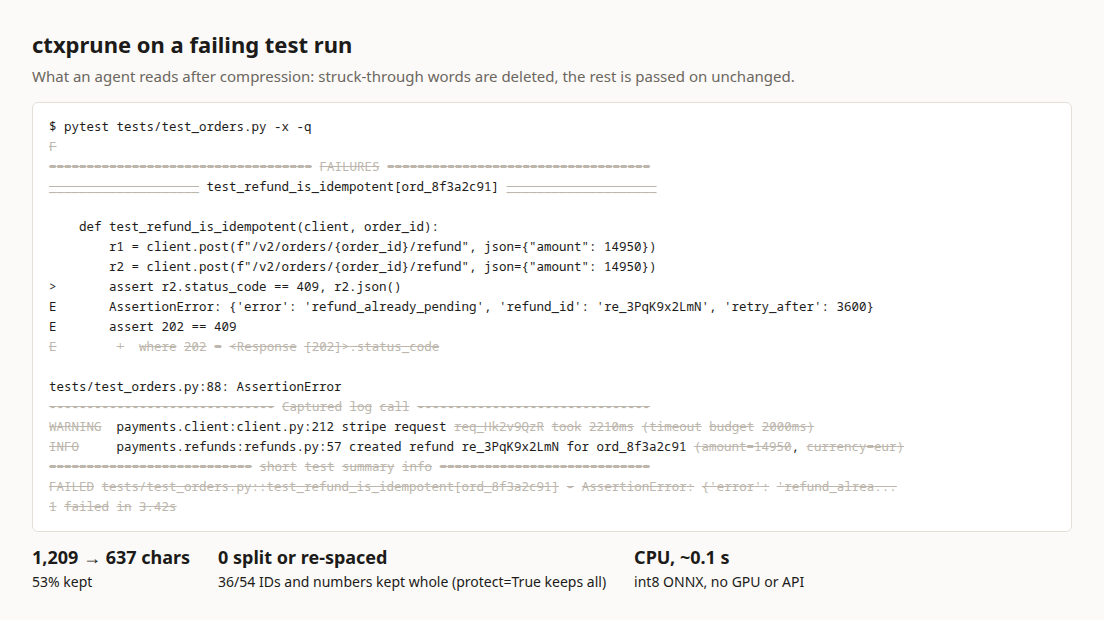
At 50% of tokens kept, a reader LLM answers 51.5% of SQuAD v2 + HotpotQA questions exactly from ctxprune's output vs 36.5% from headroom's Kompress-v2 (400 questions, 95% CI of the gap +10.5 to +19.5; the reader there is Qwen3.8-27B, which also labeled ctxprune's training data, so this may flatter ctxprune), and 68.8% vs 53.4% for LLMLingua-2-large on our agent-text set with an independent reader (DeepSeek V4 Flash). Try it in your browser (nothing is uploaded).
pip install ctxprune
ctxprune build.log --keep 0.5          # or: some_command | ctxprune --keep 0.33 --protect
import ctxprune
short = ctxprune.prune(tool_output, keep=0.5) # protect=True never drops IDs, numbers or paths| You want to... | Use | |
|---|---|---|
| Shrink big Bash/MCP outputs inside Claude Code | ctxprune install claude-code |
or the plugin: /plugin install ctxprune --marketplace riceharvest/ctxprune |
| Compress a file or a pipe from the shell | ctxprune FILE --keep 0.5 |
--protect, --stats, reads stdin |
| Call it from Python | ctxprune.prune(text, keep=0.5) |
Compressor for batching and options |
| Call it from another language / avoid the model load | ctxprune serve |
POST localhost:8719/compress {"text": ...} |
| Compress retrieved documents in LangChain | CtxpruneDocumentCompressor |
see below |
| Compress retrieved nodes in LlamaIndex | CtxpruneNodePostprocessor |
see below |
| Use it inside LLMLingua | PromptCompressor(model_name="darioooooo0o/ctxprune-small", use_llmlingua2=True) |
needs LLMLingua#261 |
| Run the raw model (ONNX / transformers / transformers.js) | model card | label 1 = keep |
Agents setting this up for a user: see AGENTS.md.
pip install ctxprune && ctxprune install claude-code # undo: ctxprune uninstall claude-codeThis adds a PostToolUse hook. Bash and MCP outputs over 6,000 characters are compressed to about half before
Claude reads them, with identifiers, numbers and paths always kept. Claude gets a one-line note saying so, and the
full output is saved under ~/.cache/ctxprune/outputs/ so it can grep the original if a detail is missing.
Commands that print files Claude may edit (cat, head, sed -n, git diff/show) and the Read/Grep tools are
never touched, and a command containing CTXPRUNE_OFF=1 is passed through. If anything fails, Claude gets the
original output. Settings: CTXPRUNE_RATE (0.5), CTXPRUNE_MIN_CHARS (6000). Each compressed call loads the model
(~2 s); run ctxprune serve in the background and the hook uses it instead.
As a plugin, without touching settings files (needs ctxprune on PATH, or uv so it can run via uvx):
/plugin install ctxprune --marketplace riceharvest/ctxprune. The plugin does not pre-download the model, so the
first large outputs pass through uncompressed while it downloads (~180 MB); run ctxprune serve once, or
python -c "import ctxprune; ctxprune.prune('x')", to fetch it up front.
Saved originals in ~/.cache/ctxprune/outputs/ are raw tool output (which can include secrets) and are never
deleted automatically; clear them with rm -rf ~/.cache/ctxprune/outputs.
from ctxprune.integrations import CtxpruneDocumentCompressor    # LangChain
retriever = ContextualCompressionRetriever(base_compressor=CtxpruneDocumentCompressor(rate=0.5),
                                           base_retriever=base_retriever)

from ctxprune.integrations import CtxpruneNodePostprocessor     # LlamaIndex
engine = index.as_query_engine(node_postprocessors=[CtxpruneNodePostprocessor(rate=0.5)])- Compression loses information. On our agent set, QA accuracy goes from 91.8% uncompressed to 68.8% at 50% kept. Use it where the token savings are worth that, e.g. long logs, test output, search results, retrieved docs.
- Weak spots: source code (the teacher rarely deleted code, so the model keeps most of it) and non-English web prose, where LLMLingua-2-large still does better.
- Our 378-question set is from our own training distribution, and the neutral SQuAD/HotpotQA comparison used our labeling teacher as the reader; neither is a fully independent benchmark. Per-source tables and caveats: model card.
By @imdariotoo.
Why: LLMLingua-2 (Microsoft, Mar 2024) was trained only on meeting transcripts under CC BY-NC-SA labels. On agent tool outputs it loses or mangles about half of all identifiers (UUIDs, IPs, paths, versions) and breaks JSON.
| step | script | where | notes |
|---|---|---|---|
| corpus | scripts/build_corpus.py |
CPU, ~2 min | ranged parquet reads from 8 permissive sources; split per repo/server/site |
| labels | scripts/label.py |
teacher LLM (scripts/teacher_up.sh) |
deletion-only compression, LCS-aligned to atoms; cached |
| train | scripts/train.py |
any torch device (we used an Intel Arc Pro B70) or CPU | token classifier, label 1 = keep (LLMLingua-2 convention) |
| quick eval | scripts/eval_quick.py |
CPU | identifiers lost, JSON validity, char ratio vs LLMLingua-2 |
| QA eval | scripts/eval_qa.py questions/answer |
teacher LLM | can a reader still answer from the compressed text |
scripts/run_v1.sh runs corpus and labels; scripts/after_label.sh runs everything after them.
SWE-smith trajectories (MIT), SWE-rebench OpenHands trajectories (CC BY 4.0), Toucan-1.5M MCP tool calls (Apache-2.0), github-code-clean filtered to MIT/Apache/BSD/ISC files, FineWeb-Edu and FineWeb-2 (ODC-BY), oasst2 (Apache-2.0). Every chunk records its dataset, license and source reference. Teacher: Qwen3.8-27B GPTQ (Apache-2.0 outputs).
Nothing has to be redone:
- More data, same mix. Rerun
build_corpus.pyinto the same directory with a larger--total. Sampling is deterministic, and dataset revisions are pinned inchunks/revisions.json, so every source file becomes a superset of the old one. To weight a domain up, add--mix toucan_mcp=0.3. - Label only the new chunks. Rerun
label.py. The teacher cache is keyed by (prompt version, model, text), so old chunks come back from disk. - Continue training from the previous model:
train.py --data <dir> --init-from runs/v1-mmbert-small/final --out runs/v2-...(or--resumeto continue an interrupted run from its checkpoint).--dataaccepts several directories, to mix label sets. - Re-run evals. Question and answer caches mean only new contexts cost LLM calls.
Changing the teacher prompt bumps PROMPT_VERSION in ctxprune/teacher.py, which
invalidates the cache on purpose.
uv run pytest: atom round-trips, identifier atoms, CJK handling, LCS
alignment, chunk budgets, split stability and cache resume.